Cliffside Park vs. Edgewater: You're Not Buying the Same View
August 27, 2026
August 27, 2026
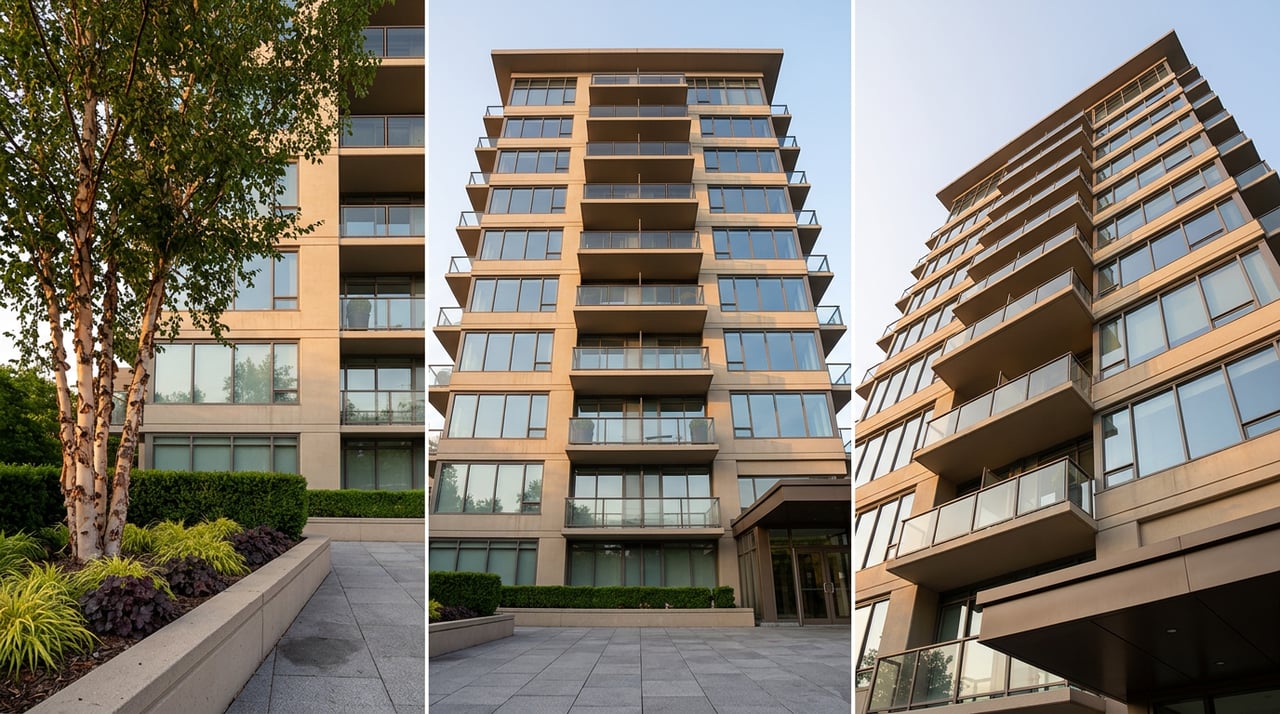
Pull up a listing in Cliffside Park next to one three minutes away in Edgewater and the photos can look interchangeable. Floor-to-ceiling glass, a private balcony, the same slice of Manhattan skyline framed in the window. The prices rarely match, and buyers who assume the gap is simple luxury markup end up confused when the numbers don't line up the way the photos suggested. It isn't markup. It's two towns pricing the same view through two different mechanisms, and only one of them has anything to do with touching the water.
Cliffside Park has no river frontage of its own. Its entire identity as a Gold Coast market rests on the fact that it sits directly on top of the Palisade, the cliff that gives the region its name. That geography changes what a developer has to build in order to sell a Manhattan view.
Take One Park at 320 Adolphus Avenue. The 14-story, 204-unit building, completed in 2019 by DMG Investments, markets itself around a single fact: it sits roughly 240 feet above ground level, high enough to deliver an unobstructed Hudson and Manhattan sightline from units that are blocks back from the water rather than sitting on it. Older buildings in town run on the same logic. Winston Towers and Carlyle Towers were built decades earlier on the same cliff-top principle, and smaller condo buildings like Cliffhouse, Chateau, and the Greenhouse sell some version of the same pitch to buyers at lower price points: pay for the floor, not the frontage.
Edgewater's version of the same view works differently, because it depends on proximity rather than height. The borough's waterfront corridor runs long, and how much sky and skyline a specific address actually delivers can vary from block to block depending on what's been built between a given unit and the river. In Cliffside Park, height does most of the work on its own. A buyer doesn't need to study a site plan to know what a 20th-floor unit will show them.
The purchase-price gap between the two towns is real, and it shows up consistently across 2026 listing data.
| Cliffside Park | Edgewater | |
|---|---|---|
| Condo median list price | about $528,000 (Aug. 2026) | town-wide median list price about $669,000 (July 2026) |
| Recent median sale, all home types | about $600,000 (May 2026) | about $710,000 (March 2026) |
| 2025 general property tax rate | 2.836 per $100 assessed value | roughly 1.645 per $100 assessed value |
| Primary Manhattan commute | NJ Transit bus | ferry |
That Edgewater sale figure deserves a caveat before anyone treats it as gospel. It came from just 13 recorded sales that month, up from 6 a year earlier, and the resulting 29 percent year-over-year jump says more about a thin trading month than a full re-rating of the market. Cliffside Park's larger, steadier condo stock moves in higher volume, which makes its pricing a more dependable comparison point month to month.
The price gap alone tells buyers that Cliffside Park is the discount answer to Edgewater's premium. The tax bill complicates that story.
New Jersey's 2025 general tax rate table puts Cliffside Park at 2.836 per $100 of assessed value, with an official effective rate of 1.92 percent. Edgewater's rate for the same year runs closer to 1.645 per $100, meaningfully lower. That gap has little to do with which town spends more on services and everything to do with ratables. Edgewater packed an outsized share of high-value commercial and luxury-condo assessments onto a small waterfront footprint, which spreads the tax burden across more assessed value than a bus-route town like Cliffside Park can match acre for acre.
The practical effect: the lower purchase price on the cliff comes with a partly offsetting higher carrying cost every year after closing. Anyone comparing the two towns on price per square foot alone is comparing half the number. Run the full monthly figure, taxes included, before deciding which one is actually cheaper to own.
Past the numbers, the two towns commit a buyer to two different daily routines. Cliffside Park's Manhattan access runs through NJ Transit bus service, including the 156 along Palisade Avenue and the 159, which also serves Fort Lee. Edgewater's defining commute is the Edgewater Ferry, running weekdays to W 39th Street in Midtown, with downtown-bound riders transferring at Port Imperial.
Neither option is better on paper. They're different products built around different failure points. A bus schedule lives or dies on street traffic and bridge congestion. A ferry schedule lives or dies on river conditions and weather delays. A buyer commuting to a fixed Midtown office five days a week may find the ferry worth every dollar of Edgewater's premium. A buyer who wants flexible daytime and evening trips, or who works somewhere the ferry doesn't reach directly, may get more use out of the bus network running along Palisade Avenue's commercial strip.
Cliffside Park's high-rise stock exists in its current form because of what used to sit on that cliff before it. The 38-acre Palisades Amusement Park operated from 1898 to 1971 on land that today holds most of the borough's Hudson-facing residential towers. When the park closed, the site was redeveloped at scale rather than sold off lot by lot, which is a large part of why so much of Cliffside Park's river-facing housing is post-1971 high-rise condominium construction rather than the two- and three-family houses that fill the town's inland streets. Edgewater went through its own industrial-to-residential conversion along the water, but on a different footprint and timeline, and the two towns ended up with distinct building vocabularies despite sharing a border.
New development in this corridor has occasionally used tax incentives to narrow the entry price further, though these offers attach to specific buildings during active sales rather than existing as a standing rule. When One Park launched sales, its developer rolled out a three-year, sponsor-paid tax program on select units, reported by Patch as worth roughly $36,000 on a one-bedroom, $58,000 on a two-bedroom, and $99,000 on a three-bedroom, based on 2019 tax estimates. That program is long closed and the building has since sold out entirely. It's a useful precedent, though, for any buyer looking at active new construction on the Gold Coast today: ask directly whether a developer is offering a comparable tax program, because an abatement changes the true cost comparison as much as the underlying rate does, and it rarely shows up in the listing photos.
Is Cliffside Park considered a waterfront town? Not the way Edgewater is. Cliffside Park has no river frontage of its own. Its waterfront identity comes entirely from elevation and sightline, not from a promenade or marina at street level.
Does an elevation view hold value the same way a direct waterfront view does? Both markets support strong high-rise resale, but the two products respond to different variables. Direct waterfront pricing tracks proximity to amenities like the promenade. Elevation-based pricing tracks floor height and a building's position on the cliff, which is why two units in the same Cliffside Park tower can price very differently depending on which floor faces the river.
Do I need a car in either town? Not necessarily. Both the Cliffside Park bus network and the Edgewater ferry support a car-optional routine for someone commuting into Manhattan. The daily rhythm and reliability of each, as covered above, are worth testing in person before committing to one over the other.
The two towns get compared constantly because they sit side by side and sell the same skyline. What they're actually selling underneath that skyline, and what it costs to carry each option past closing, is a different conversation for every building and every unit. If you're weighing a specific address in either town, Team Francesco can walk through the real numbers, floor by floor, tax bill included, before you make an offer.

Experience Matters! Make Team Francesco your #1 choice for all your real estate needs. With nearly 25 years of experience, you can trust Team Francesco is the best in the business to guide you in even the most challenging markets.
Stay up to date on the latest real estate trends.
Your Guide to Buying a Historic Home in Jersey City's Landmark Neighborhoods.

Great Options Include Hudson Valley and the Poconos.
And How It Pays to Be an Informed Buyer in Jersey City.
We are there to serve and educate you every step of way, whether you’re seeking or selling property in the local area, or relocating anywhere around the globe. Count on us to listen to your needs, respect your privacy, and deliver the best sales experience possible.